How to Make 30K/Month With AI Influencers: Playbook
A realistic AI influencer automation playbook for virtual creators: niche selection, ethical monetization, disclosure, content workflows, distribution.

Disclosure: Independent guide from Fuxux. We are not affiliated with the platforms or third-party tools mentioned in this article. Product names belong to their owners.
The phrase how to make 30K month with AI influencers attracts attention because it sounds like a shortcut. The real version is less magical and more operational: a virtual character, a clear niche, a product with real demand, transparent AI disclosure, repeatable short-form content, and a measurement loop that turns attention into revenue.
This guide turns the AI influencer idea into a practical automation playbook. It does not promise income, hide risk, or pretend synthetic creators are a loophole. It explains what would need to be true before an AI influencer account could become a serious business.
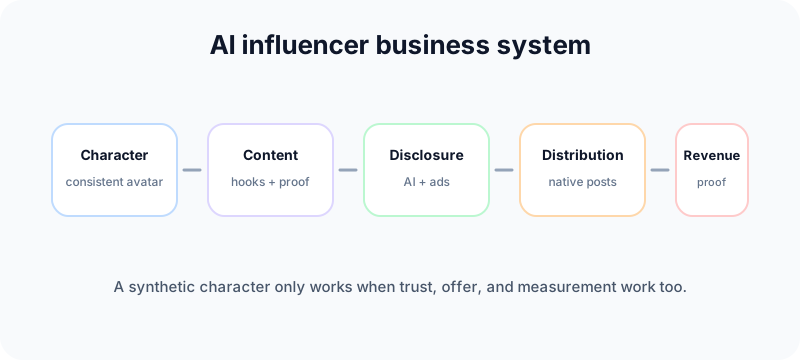
Quick answer: what the AI influencer playbook really is
A serious AI influencer workflow has six parts:
- Pick a narrow audience and problem.
- Create a consistent virtual character with clear disclosure rules.
- Build or choose a product that fits the audience.
- Produce short-form content around hooks, proof, objections, and calls to action.
- Distribute across Reels, TikTok, Shorts, and other channels without losing platform fit.
- Measure retention, clicks, trials, purchases, and refunds before scaling volume.
The monthly revenue number only becomes meaningful after those parts work together. Views alone are not a business. A realistic model needs conversion, retention, and compliance.
Start with the product, not the avatar
Most people start by designing the virtual person. That is fun, but backwards. The avatar is the media layer. The business depends on the product and audience.
Before creating a single face, answer these questions:
- What painful or aspirational problem will the account own?
- Who pays to solve that problem already?
- What product can be recommended honestly and repeatedly?
- What proof can be shown without faking personal experience?
- What platform policies apply to synthetic media and endorsements?
Fitness, skincare, fashion, productivity, language learning, finance education, and wellness can all look attractive. They are also sensitive because exaggerated claims, fake before-and-after results, or hidden sponsorships can damage trust fast.
Choose an ethical monetization model
An AI influencer can monetize in several ways. Some are safer than others.
| Model | Best when | Main risk |
|---|---|---|
| Affiliate offers | You can recommend a product with clear disclosure | Low trust if every post sells |
| Owned app or tool | You can support users and improve retention | Product quality becomes the bottleneck |
| Digital products | The account teaches a specific skill | Weak if it is just a generic PDF |
| Sponsorships | The audience is specific and measurable | Requires clear material connection disclosure |
The safest path is usually a real product with a real support loop. If the virtual creator sends users to an app, checklist, membership, or course, the offer must match what the content promises.
Understand disclosure before automation
AI influencer content touches two disclosure areas: synthetic media and commercial relationships.
Meta says it uses labels such as AI Info to help people understand when AI is used to create or alter content. Its Transparency Center explains Meta's approach to labeling AI content. YouTube also requires creators to disclose realistic altered or synthetic content in certain cases; see YouTube's official guide to disclosing altered or synthetic content.
Commercial relationships are separate. The FTC's Disclosures 101 for Social Media Influencers says influencers should make material connections to a brand obvious when endorsing products.
Practical rule: if the character is synthetic, say so where the platform expects it. If the post sells, sponsors, or earns commission, disclose that too.
Design the AI influencer like a brand asset
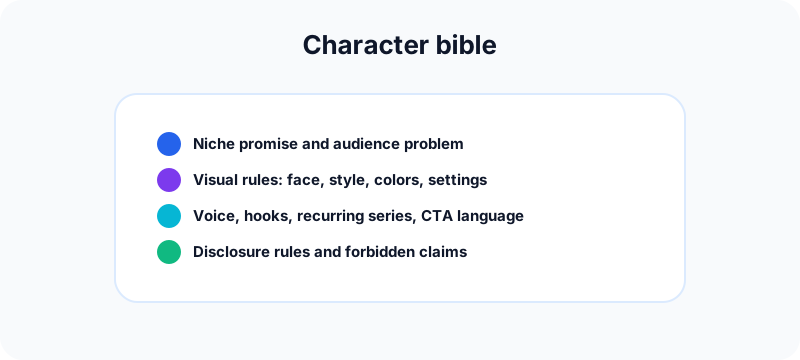
A strong virtual character has constraints. Without constraints, every post looks like a different person and the audience never builds recognition.
Define the niche promise
Examples:
- A synthetic runner testing beginner endurance routines.
- A virtual desk setup creator showing calmer productivity habits.
- An AI fashion stylist teaching capsule outfits for remote workers.
- A fictional language-learning character practicing daily phrases.
The promise should be specific enough that viewers know why to follow.
Create a character bible
Document the character's visual traits, tone, topics, forbidden claims, disclosure language, recurring settings, and product boundaries. Keep prompts, seed images, color palettes, and editing rules in one place.
Avoid fake lived experience
A synthetic character should not claim real human medical results, personal trauma, physical transformation, or financial success. Use framing like "fictional demo," "virtual creator," or "AI-generated concept" where appropriate.
Build the content engine
The account needs more than pretty renders. It needs repeatable content formats.
Format 1: problem and fix
Open with a problem the audience recognizes, then show one specific fix. This works for fitness form, outfits, skincare routines, productivity systems, and app demos.
Format 2: myth and correction
Challenge a common belief without overclaiming. Example: "Your morning routine does not need 12 steps. It needs one cue you can repeat."
Format 3: character routine
Show the virtual creator repeating a recognizable habit. Consistent series build memory: Monday reset, 10-minute stretch, three-tab workspace, nightly language drill.
Format 4: product proof
Demonstrate the product in context. Do not rely on vague hype. Show the screen, the checklist, the result, or the process.
For hook writing, connect this guide with our Reels hook framework. The first two seconds matter even more when the viewer is still deciding whether the virtual person feels worth trusting.
Map the automation workflow
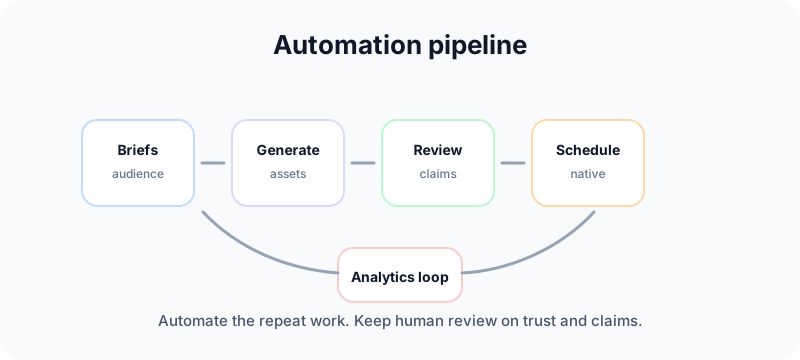
A practical pipeline looks like this:
- Research the audience's questions, objections, and buying triggers.
- Write weekly briefs for content themes and product angles.
- Generate or assemble visuals that match the character bible.
- Edit clips with hooks, subtitles, disclosure, and CTA overlays.
- Schedule platform-native versions.
- Collect performance data and tag winners by hook, topic, and offer.
Automation should remove repeated production work. It should not remove human review. Someone still needs to check claims, disclosures, brand safety, and product accuracy before publishing.
Distribution: one idea, platform-specific execution
Cross-posting is useful, but copying the same file everywhere is lazy. Each platform needs a version that fits its feed.
- Instagram Reels: strong first frame, clean cover, native captions, profile conversion path.
- TikTok: faster hook testing, trend-aware editing, clear comments strategy.
- YouTube Shorts: tighter title, synthetic media disclosure when required, retention-focused pacing.
- Pinterest: visual search angle, evergreen pins, product or tutorial framing.
- LinkedIn: founder or operator angle if the account teaches the business process.
If Instagram is a core channel, use our Instagram grid maker to keep covers coherent and our Story link guide when you need timely traffic to a launch page.
The revenue math to model before you chase scale
Do not start with the headline monthly number. Start with unit economics.
Track:
- Views per post
- Profile visits per view
- Link clicks per profile visit
- Trials or leads per click
- Paid conversions per trial
- Average revenue per customer
- Refunds, churn, ad spend, and tool costs
If the account gets views but no clicks, fix the CTA and offer framing. If it gets clicks but no purchases, fix the landing page or product. If it gets purchases but high refunds, the content is setting the wrong expectation.
SEO and content clusters for AI influencer brands
An AI influencer account should not depend only on short-form discovery. Search-friendly support content can turn a viral spike into a more durable brand. Build a cluster around the audience problem, not just around the virtual character.
Useful cluster pages and posts include:
- A beginner guide that explains the problem your product solves.
- A comparison page that helps people choose between methods or tools.
- A glossary page for niche terms the audience searches repeatedly.
- A case-study style page that shows a workflow without inventing fake personal results.
- A resources page that collects templates, checklists, or calculators.
This matters because AI influencer content can create awareness quickly, but search captures intent after the viewer starts researching. If the account teaches productivity, build resources around workflows. If it teaches fitness, build safe educational content around routines, form, and planning. If it promotes a software product, build pages around use cases, comparisons, and onboarding.
Connect short-form hooks to search pages
Each recurring video format should point to a deeper resource. A Reel or Short can introduce the problem. A Story can link to the checklist. A carousel can summarize the steps. A long-form page can answer the search query in full. That gives the virtual creator a real content ecosystem instead of a feed full of disconnected clips.
Keep claims consistent across every asset
If the landing page says one thing, the short video says another, and the disclosure appears only in a bio, the funnel creates risk. Keep the same promise, disclosure language, and CTA across Reels, TikTok, Shorts, Stories, captions, and landing pages.
What can go wrong
The character looks inconsistent
Inconsistent faces, bodies, voices, and settings break recognition. Use fewer tools and tighter prompts before increasing volume.
The account hides that it is synthetic
Hidden synthetic media may create short-term curiosity, but it damages trust and can create platform risk. Transparency is part of the product.
The content overclaims results
Fitness, beauty, finance, and health content need extra caution. Avoid fake testimonials, unrealistic transformations, and claims that cannot be supported.
The product is not good enough
No automation stack can save a product people do not want. If retention and repeat purchases are weak, slow down content volume and improve the offer.
A 14-day test plan
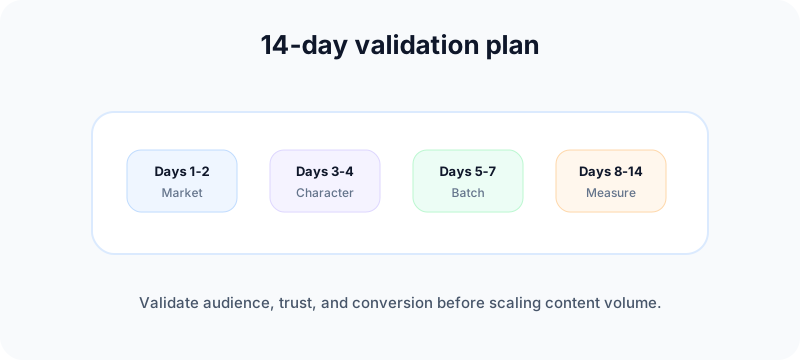
Days 1-2: Pick the market
Choose one audience, one problem, and one offer. Write down what you will not claim.
Days 3-4: Build the character bible
Create the visual rules, voice, disclosure language, and sample prompts. Generate a small set of approved reference images.
Days 5-7: Produce the first batch
Create 10 to 15 short videos across three formats: problem-fix, myth-correction, and routine. Add subtitles and CTAs.
Days 8-11: Publish and monitor
Post consistently across one or two primary channels first. Do not spread too thin before you know whether the concept holds attention.
Days 12-14: Review the funnel
Look at retention, saves, comments, profile visits, clicks, trials, and purchases. Keep winners. Rewrite weak hooks. Kill formats that get attention but no useful action.
Free Fuxux tools and related guides
- Social media growth guide: build a publishing cadence before increasing volume.
- TikTok caption generator: draft short-form caption variants for hook testing.
- Instagram carousel splitter: turn one AI influencer lesson into a carousel support asset.
- Instagram grid maker: preview how virtual creator covers look together before launching a profile grid.
- Instagram handle checker: validate a clean handle before building the virtual brand identity around it.
- YouTube title checker: refine Shorts titles when the same synthetic creator content goes to YouTube.
- YouTube tag generator: generate supporting topic tags for Shorts and faceless video workflows.
- Instagram posts vs Stories vs Reels: choose the right format for each campaign stage.
- Reels hook framework: improve the first frame before scaling AI-generated clips.
- How to make faceless YouTube videos: compare AI influencer content with lower-risk faceless workflows.
- Social media aesthetic: keep the virtual brand recognizable across posts.
Frequently asked questions
Can an AI influencer account really become a high-revenue business?
It can, but only if the audience, product, trust, distribution, and economics work together. The character alone does not create revenue.
Do I need to disclose that the influencer is AI-generated?
Often yes, especially for realistic synthetic media or platform-specific upload requirements. You should also disclose sponsorships, affiliate relationships, or paid endorsements clearly.
What niche is best for AI influencers?
The best niche has visible content, repeatable problems, clear products, and low risk of misleading claims. Start narrower than you think.
Should I build my own product or use affiliate offers?
Affiliate offers are faster to test. Owned products give more control, but they require support, retention work, and higher responsibility for the customer experience.
How many posts should I publish per day?
Start with enough volume to learn, not enough to flood. One or two strong posts per day on a primary platform can teach more than five rushed posts across every channel.
Bottom line
An AI influencer business is not a money button. It is a media, product, and compliance system. The operators most likely to win are the ones who disclose clearly, build real offers, test content honestly, and measure conversion instead of chasing screenshots of views.
If you want to pursue the 30K per month idea, treat it as a model to validate. Start small, keep the claims clean, learn what the audience rewards, and scale only after the numbers prove the system.
About the author
I build Fuxux, a scheduler that publishes to 12 platforms from one queue. I write about the parts of posting that are actually fiddly — what each platform will and won't let you schedule natively, where the API limits bite, and how to keep a queue running without babysitting it.
Ready to post smarter?
Fuxux handles the scheduling, the formatting, and the AI captions — so you can focus on ideas.
Start free — no credit card