Why Your Reels Aren't Going Viral: Hook Framework
Use this Reels hook framework to diagnose weak first frames, rewrite better Instagram hooks, test variants.

Disclosure: Independent guide from Fuxux. We are not affiliated with the platforms or third-party tools mentioned in this article. Product names belong to their owners.
If your Reels are not going viral, the first place to inspect is usually not the camera, the caption, or the posting time. It is the opening frame. A Reel can have useful advice, good production, and a strong offer, but if the first two seconds feel familiar or unclear, most viewers leave before the real content starts.
This guide gives you a practical Reels hook framework you can use before publishing: context, audience, curiosity, payoff, and testing. The goal is not to promise virality. The goal is to make the first seconds easier to understand, harder to ignore, and easier to measure.
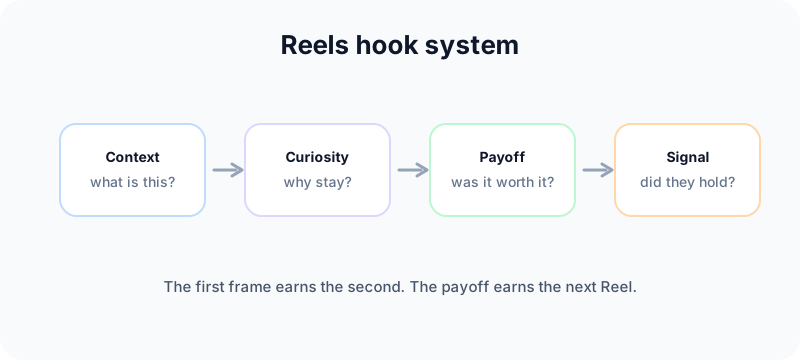
Quick answer: why your Reels are not going viral
Most underperforming Reels fail early for one of five reasons:
- The first frame does not explain what the Reel is about.
- The hook is too generic, so nobody feels directly addressed.
- The opener gives away the best part too soon.
- The visual does not match the promise in the text or voiceover.
- You are not testing hook variants, so you cannot tell what your audience actually holds for.
Instagram has said that ranking looks at many signals, including information about the post, the person who posted, and how people interact with content. Instagram's own ranking explanation is worth reading because it makes one thing clear: viewer behavior matters. If people leave immediately, the system receives a weak signal before the content has a chance to work.
The Fuxux Reels hook framework
Use this framework before filming or editing. It is simple enough to run on every Reel, but strict enough to catch vague openers before they waste a post.
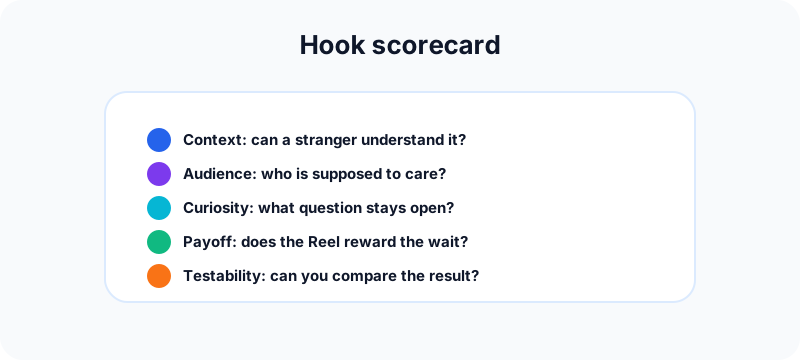
1. Context: can a stranger understand the setup?
A hook can be surprising without being confusing. The viewer should understand the category of the Reel almost instantly: fitness, marketing, recipe, founder lesson, product demo, camera tip, design critique, or personal story.
Weak context:
- "I stopped doing this and everything changed."
- "Nobody talks about this."
- "This is the mistake."
Better context:
- "I stopped opening client Reels with my logo."
- "Nobody tells new photographers why travel reels stall."
- "This is the editing mistake that makes recipe Reels feel slow."
The second group still creates curiosity, but it gives viewers enough information to decide whether the Reel is for them.
2. Audience: who is supposed to care?
Generic hooks feel safe because they exclude nobody. That is also why they are forgettable. A good hook names the viewer through the problem, identity, stage, or desire.
Examples:
- For coaches: "If your coaching Reels get saves but no calls, check this opening."
- For creators: "Small creator mistake: your best clip is arriving too late."
- For ecommerce: "Product Reel not converting? Your first frame may be selling the wrong thing."
- For agencies: "Client Reels should not open like portfolio slides."
You do not need to name every demographic. You need one clear person to feel, "That is my problem."
3. Curiosity: what question stays open?
Curiosity is the gap between what the viewer knows now and what they want to know next. The hook should open that gap without turning into bait.
Good curiosity comes from tension:
- Common belief vs hidden detail
- Expected result vs unexpected reason
- Before state vs missing step
- Obvious tactic vs overlooked constraint
Example: "Your hook is not too boring. It is too complete." That line opens a question. What does complete mean? Why would complete be bad? The Reel can then explain that giving away the answer in the first second removes the reason to keep watching.
4. Payoff: can you reward the wait?
A hook that opens a loop must close it honestly. If the payoff is thin, viewers feel tricked and the next Reel gets less trust. The promise should match the content.
Before publishing, write the hook and the payoff side by side:
| Hook promise | Real payoff needed |
|---|---|
| "Your Reel loses people in the first second." | Show the first-frame problem and the fix. |
| "This caption is killing the video." | Explain the mismatch between caption and visual. |
| "Most product demos start too late." | Show the delayed demo and a faster version. |
5. Testability: can you compare it later?
If every Reel uses a totally different format, topic, edit, length, and hook, your analytics will be noisy. You need enough variation to learn, but not so much that every result is a mystery.
For one idea, test two or three hooks with the same core footage:
- Hook A: problem-first
- Hook B: contradiction-first
- Hook C: result-first
Then compare retention, replays, saves, comments, profile visits, and follows. Views are not useless, but views alone do not explain whether the opener did its job.
Why the first two seconds matter so much
Reels compete in a feed where people are making instant decisions. The viewer is not reading your full thesis. They are asking a fast subconscious question: should I stay?
That decision is shaped by:
- Visual clarity: can they tell what they are looking at?
- Text clarity: can they understand the premise quickly?
- Relevance: does it sound like their problem?
- Motion: does something change soon enough to feel alive?
- Trust: does the hook sound useful or manipulative?
If you want a broader format decision guide, pair this with Instagram posts vs Stories vs Reels. Reels are built for discovery, but discovery only helps when the first frame earns the next second.
Four hook templates that stay useful
Templates are not scripts. Treat them as structures you customize for your niche.
The mistake hook
Use when the Reel fixes a common behavior.
Template: "You are not [bad outcome] because of [obvious reason]. It is probably [specific hidden reason]."
Example: "Your Reels are not stalling because your niche is boring. The first frame gives people no reason to wait."
The contradiction hook
Use when you are challenging a common assumption.
Template: "The [popular tactic] is not the hook. The hook is [less obvious thing]."
Example: "The trending audio is not the hook. The first visible problem is the hook."
The teardown hook
Use when you can show a before-and-after or critique your own content.
Template: "This Reel almost worked. Here is the frame that lost people."
This format works well because it promises evidence, not opinion.
The narrow audience hook
Use when your content is for a specific person.
Template: "If you are [specific identity] and [specific pain], fix this before posting another Reel."
Example: "If you are a fitness coach and your Reels get likes but no leads, fix the first sentence before posting another workout."
The hook diagnostic: score your opener before you post
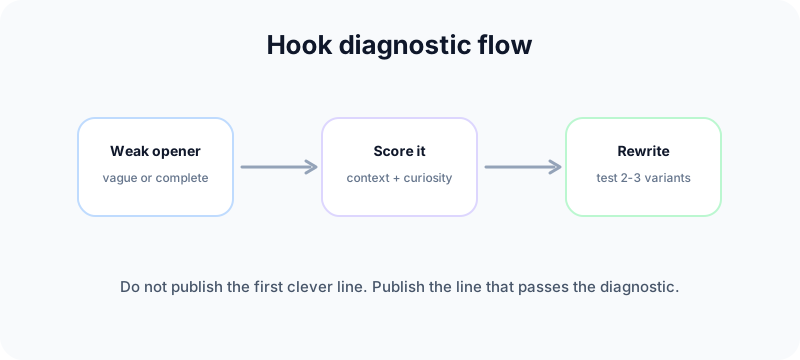
Give each hook one point for each yes:
- Can a new viewer understand the topic in one second?
- Does the hook speak to one clear audience?
- Does it open a question without using fake drama?
- Does the visual support the text or voiceover?
- Does the payoff actually answer the hook?
- Can this hook be compared against another variant?
A score of 5 or 6 is ready to test. A score of 3 or 4 needs revision. A score below 3 usually means the idea is not shaped enough yet.
What to measure after publishing
If you only measure views, you will overvalue noisy spikes and undervalue reliable formats. Use a cleaner read:
- Retention: did people stay through the opening?
- Average watch time: did the video hold attention after the hook?
- Replays: did the Reel create enough value or surprise to watch again?
- Saves: did people want to use the idea later?
- Comments: did the hook create a specific response?
- Profile visits and follows: did the viewer want more from you?
Instagram notes that professional accounts can access insights for their content. If you do not have Insights available, start with our guide on how to change Instagram to a business account.
Hook mistakes that look smart but hurt retention
Opening with the brand intro
Your logo, title card, or podcast clip intro is not automatically interesting to a cold viewer. Put the problem or result first. Brand recognition can come after relevance.
Using vague drama
"This changed everything" and "You need to hear this" often feel empty because they do not name the viewer, problem, or payoff. Specificity creates trust.
Showing the reveal too early
If the first frame gives away the final result, the viewer may not need the rest. Save the strongest reveal until the Reel has earned it.
Writing for the caption instead of the screen
Captions help, but many viewers decide before reading them. The on-screen text, first visual, and first spoken line should work together.
Build a simple hook testing workflow
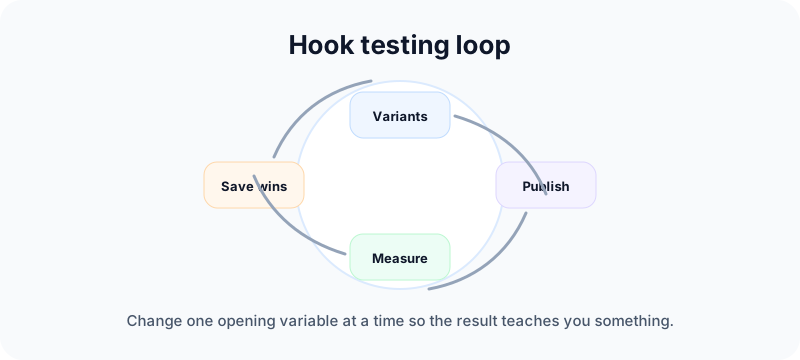
Use a repeatable loop:
- Write one content idea in a single sentence.
- Create three hook variants: problem, contradiction, teardown.
- Film or edit the same core idea once.
- Swap only the first two or three seconds for each variant.
- Publish across a controlled window.
- Measure early retention and saves after enough time has passed.
- Save the winning structure in a hook library.
Do not turn every test into a full production. The point is to learn which opening structure your audience rewards.
Turn one Reels hook into a content cluster
The best hooks usually reveal a larger idea. Do not leave that idea trapped in one Reel. Turn the same premise into supporting assets so the topic has more chances to rank, earn saves, and move people deeper into your profile.
A simple cluster can look like this:
- Reel: the fast hook and visual example.
- Carousel: the checklist, before-and-after, or scorecard.
- Story: the quick poll, link, or behind-the-scenes explanation.
- Comment thread: the objection handling and extra examples.
- Longer post: the complete framework for people who want the full reasoning.
This helps SEO because the page is no longer isolated around one phrase. It sits inside a cluster of Reels hooks, Instagram retention, short-form strategy, content repurposing, creator workflow, and social media testing.
Use comments to extend the hook
If the Reel gets questions, use the first comment or pinned comment to clarify the promise. A good comment can turn a hook into a discussion instead of a one-way clip. For examples that do not sound automated, use our Instagram comment ideas guide.
Use Stories to test the next hook
Stories can help validate whether an audience cares about the next angle. Run a poll, share two hook options, or link to a deeper resource with the workflow in our Instagram Story link guide.
Free tools and related Fuxux workflows
- Social media growth guide: plan a weekly content cadence so hook testing does not become random posting.
- Instagram grid maker: keep Reel covers visually consistent with your profile.
- Instagram carousel splitter: turn the same hook idea into a carousel that supports the Reel.
- TikTok caption generator: adapt a winning Reels hook into TikTok caption variants without copying the same wording.
- YouTube title checker: sharpen Shorts titles when the Reel idea is repurposed to YouTube.
- YouTube tag generator: create supporting tag ideas for Shorts when the topic has alternate phrasing.
- LinkedIn text formatter: turn a hook teardown into a cleaner LinkedIn post for a professional audience.
- Instagram comment ideas: turn hook-driven attention into better comment threads.
- Social media aesthetic: make first frames recognizable without wasting time on brand intros.
- AI caption writing for social media: turn the same premise into platform-specific caption drafts.
Frequently asked questions
Does a better hook guarantee a viral Reel?
No. A stronger hook improves the chance that viewers stay long enough to judge the content. Virality still depends on audience fit, content quality, timing, distribution, and many platform signals.
How long should a Reel hook be?
Usually one sentence or one clear first-frame idea. The viewer should understand the premise quickly, but the best detail should arrive later as the payoff.
Should I use trending audio?
Trending audio can help the feel of a Reel, but it cannot fix a vague first frame. Use audio to support the hook, not replace it.
How many hook variants should I write?
Three is a practical minimum: one problem-first hook, one contradiction hook, and one teardown or proof hook. More is useful only if you can still compare results cleanly.
What is the biggest hook mistake?
Giving viewers either too little context or the whole answer too early. A good hook gives enough context to care and enough unanswered tension to stay.
Bottom line
If your Reels are not going viral, do not jump straight to posting more or changing your niche. Audit the opening. A better hook gives viewers context, names the right audience, opens a real question, and rewards the wait with a useful payoff.
The best creators do not treat hooks as lucky phrases. They treat them as testable parts of the content system. Start there, measure what holds attention, and build a library of openings your audience has already proven they care about.
Publishing to Instagram regularly? See how scheduling works for Instagram.
About the author
I build Fuxux, a scheduler that publishes to 12 platforms from one queue. I write about the parts of posting that are actually fiddly — what each platform will and won't let you schedule natively, where the API limits bite, and how to keep a queue running without babysitting it.
Ready to post smarter?
Fuxux handles the scheduling, the formatting, and the AI captions — so you can focus on ideas.
Start free — no credit card